
Hardware
LoDi-Switcher
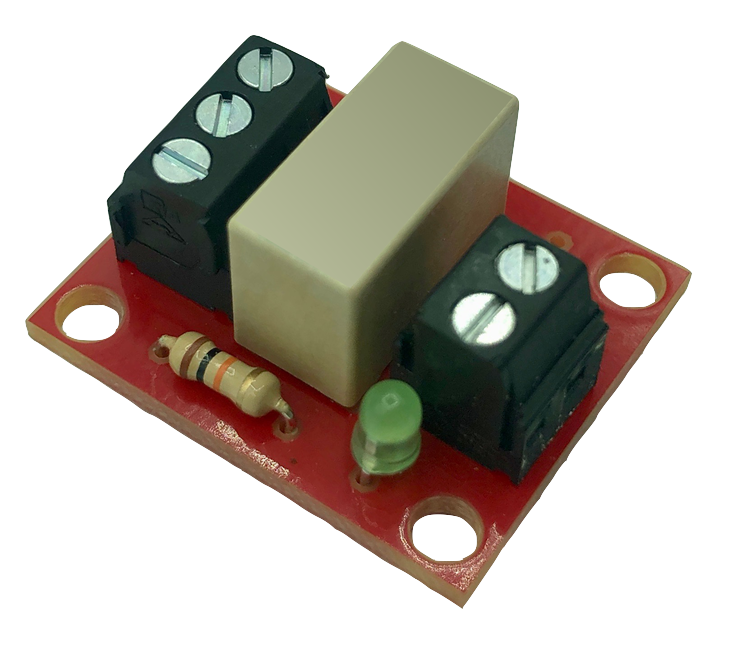
Introducing:
The LoDi-Switcher series.
For switching all sorts of extras on the layout.
We use the relay when switching our two/three-rail layout over.
You can also use it to cut power to track, or for analogue sections.
For anything, in short, that can be switched in.
As always, we paid attention to build quality.
Please note: always work with ferrules where you can.
You will find those and the matching model railway cable in our LoDi shop.
Features of the LoDi-Switcher
- A relay board for switching monostable or bistable relays.
- LED indication showing that the relay is being driven
- Switches consumers up to 2 amperes.
- 12 to 24 volt range for the coil supply
1. The LoDi-Switcher and its versions
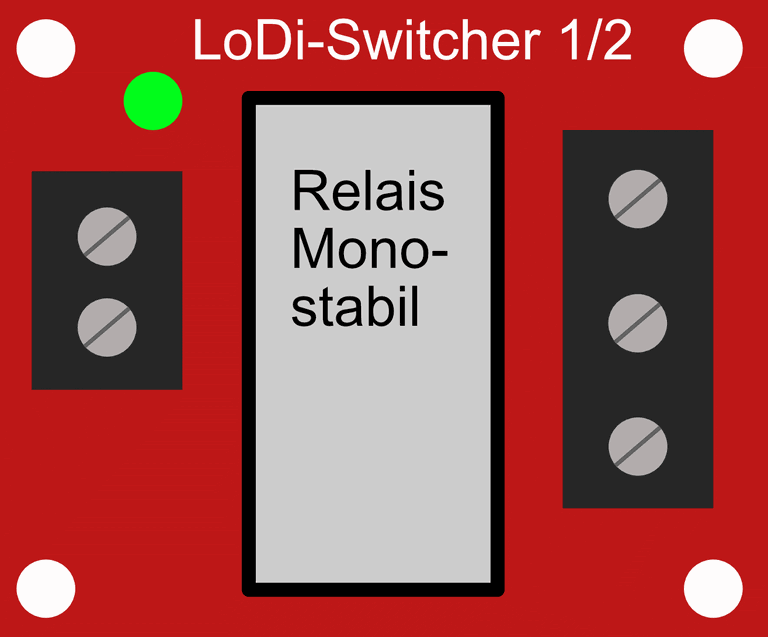
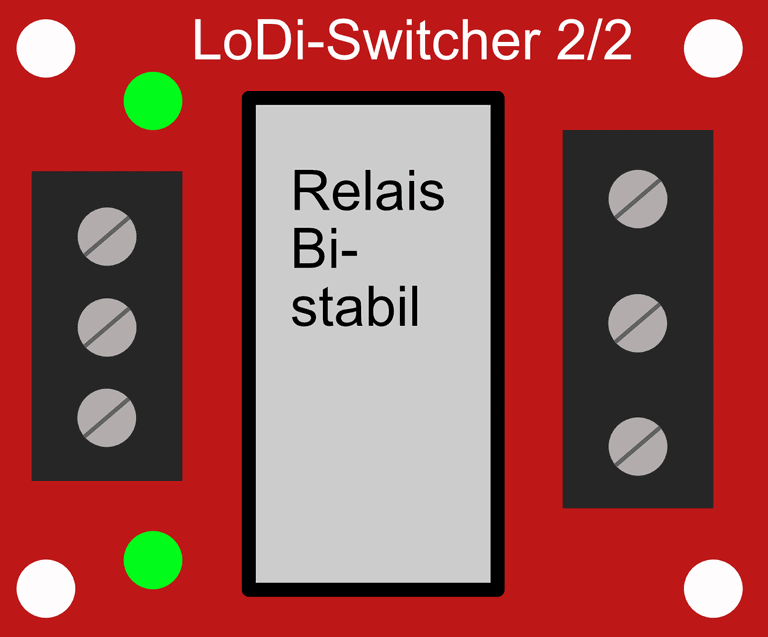
The LoDi-Switcher comes in a 1/2 monostable and a 2/2 bistable version.
Here are the different versions:
2. The LoDi-Switcher and its connections
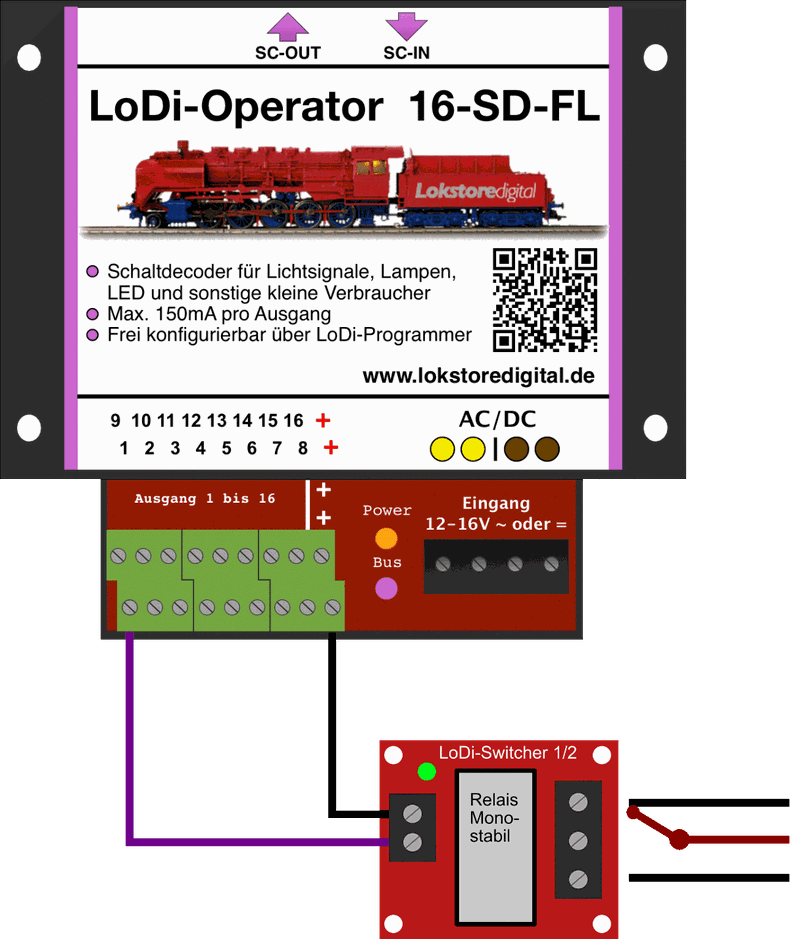
The LoDi-Switcher has a connection for the supply that switches the relay. Any conventional decoder can be used for this. Here we show a version with the LoDi-Operator 16-SD-FL.
This shows version 1/2.
The monostable relay needs continuous current to hold the contact. If the current drops, it releases or switches over.
On the side of the LoDi-Switcher there is an LED; that is where you connect the decoder.
On the opposite side is the relay's switching channel. It switches the centre connection against the upper or the lower one.
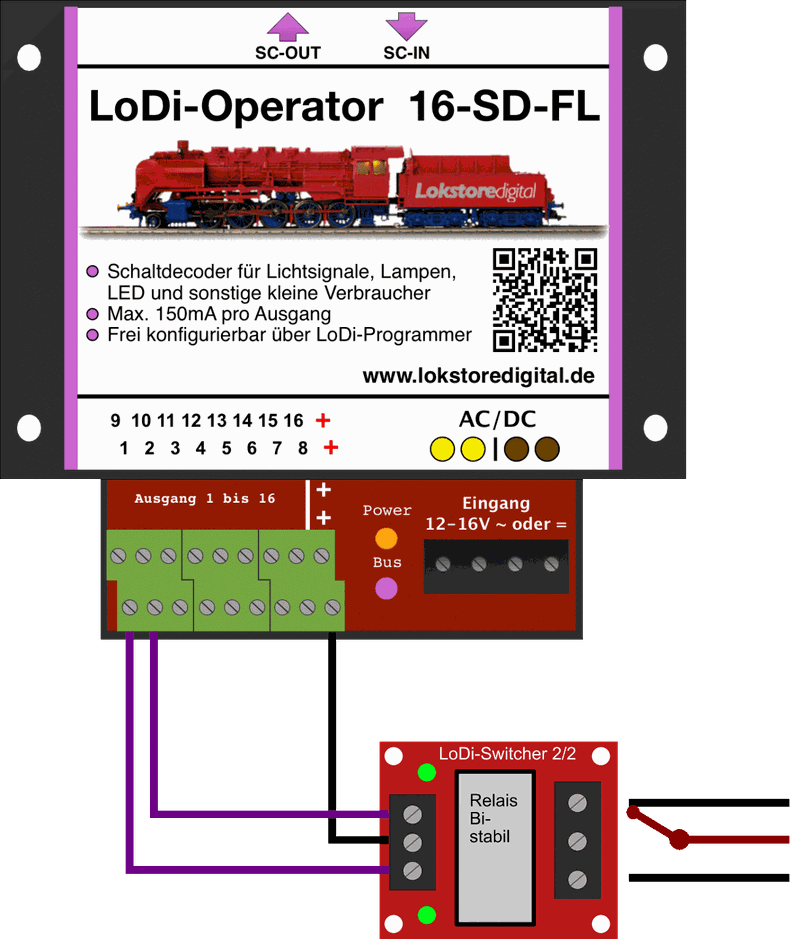
Here you see the bistable version of the relay, version 2/2.
With this version the relay coil always stays latched to one side and cannot release if the current is lost. A single pulse is enough to switch it over.
3. Technical data
The LoDi-Switcher carries a total of 2 amperes.
12–24 volt AC or DC input
| Property | Value |
|---|---|
| Dimensions | Length: 26 mm |
| Width | 22 mm |
| Height | 13 mm at its highest point |
| Weight | 4 g |

Would you like to see the quality of the devices for yourself?
Visit our forum, where experienced users are glad to help.